Oransi creates HEPA air purifiers for home use. The company began with an engineer’s quest for better indoor air quality. CEO Peter Mann, parent of an asthmatic son, believed existing medications and purifiers were not improving his family’s quality of life — so Oransi was born.
For over a decade, Oransi has worked with American air filtration experts to improve HEPA and carbon filtration. Their work has helped tens of thousands of families enjoy cleaner indoor air.
The challenges
Oransi had an underutilized email channel and minimal revenue from email campaigns. They understood email’s potential but needed a stronger strategy.
They moved from Mailchimp to Klaviyo and needed a smooth data migration plus reliable integration between Volusion (their eCommerce platform) and Klaviyo so behavioral and order data could power automations.
Before peak season, re-engaging a dormant list risked high spam, bounce, and unsubscribe rates — there was little recent engagement data to guide segmentation.
The solutions
1. Volusion–Klaviyo integration
Essence of Email worked with Volusion to connect store data to Klaviyo. After go-live, Oransi’s email data aligned with Volusion shopping insights, and Mailchimp history was migrated into Klaviyo. The integration also benefits other Volusion merchants using Klaviyo.
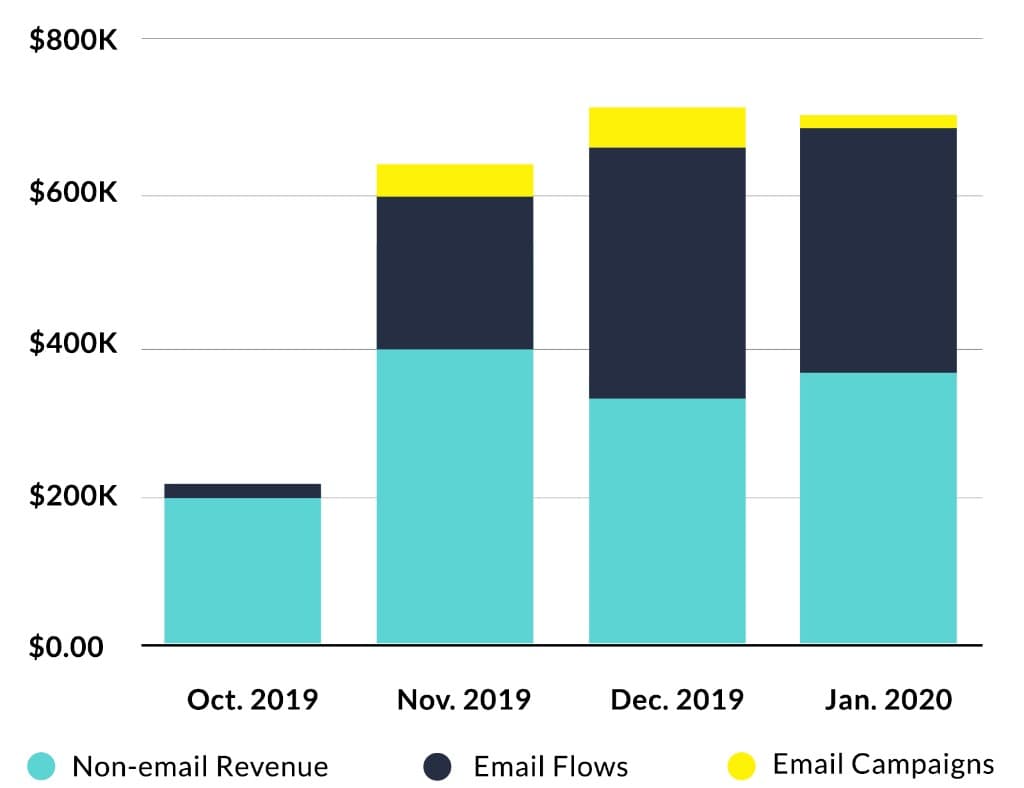
With Volusion’s fast, mobile-optimized checkout and strong mobile email engagement, Oransi was positioned to convert more mobile traffic — email revenue grew from about $5,000 to over $260,000 per month.
Monthly revenue by channel
After go-live, monthly email revenue moved from a low baseline to a peak above a quarter-million.
2. Shortening long purchase cycles with automation
Air purifiers are rarely impulse purchases; buyers research quality and price. We built personalized automations that support the full journey. In the first month, automated flows generated 78% of overall email revenue.
First month: flows vs. campaigns
In the first month automations were live, automated flows accounted for the majority of email revenue.
- Welcome series: a 10% discount incentive and a four-email sequence introducing the brand, what to look for in a filter, social proof, and a product offer. The Welcome Flow outperformed other flows combined.
- Abandonment coverage: browse, cart, checkout, and exit-intent follow-ups powered by the Volusion–Klaviyo integration.
We tested timing for browse abandonment — for example, 2-hour vs. 4-hour delays — and the 2-hour variation won.
3. BFCM resend tactics
For Black Friday / Cyber Monday, we ran a resend to subscribers who did not open the original promo within 24 hours. That follow-up added roughly 20% more email revenue on top of the first send.
BFCM: resend lift
Resending to non-openers within 24 hours added roughly 20% more email revenue versus the first promo send alone.
4. Re-engagement before high season
After the ESP move, limited engagement data was available (nothing meaningful from the prior 90 days). Instead of blasting the full list, we rebuilt segments manually and phased re-engagement: part of the list first, then additional segments. Open rate moved slightly (21.9% to 20%) while click rate rose (1.7% to 1.9%) — a sign that gradual, targeted sends kept engagement healthier than a single bulk blast.
The results
- $624,000 in email revenue in under three months
- In December, two months after program setup, email revenue outperformed all other store channels by 14%
- BFCM resends added ~20% email revenue vs. the original BFCM campaign alone
- Automated flows drove 78% of email revenue in the first month they were live
Email revenue grew month over month, with automation continuing to outperform one-off campaigns — freeing the team to invest in other channels while flows compound.
Book a strategy call to explore what a similar program could look like for your brand.